Showing posts with label history. Show all posts

Tuesday, November 29, 2016

The Past is Now: How Whitewashing History Upholds Racism Today

Last year, I started drafting a snarky takedown of that hideously awful, whitewashed nonsense that was Exodus: Gods and Kings. I never finished it (nor did I sully my brain or wallet with paying to watch the whole thing - trailers and reviews were plenty) until now. It’s not really about a terrible movie and Hollywood’s habit of casting white people where they do not belong. It’s much, much bigger than that.

Many people only interact with history via representations in TV and movies. Such media has a unique responsibility to show the facts of a diverse, global past, in which people of color were architects of great civilizations.

This movie did look really, really bad, though. Exodus: Gods and Kings was the latest film in a trend of turning fire-and-brimstone Old Testament stories into All-Out Action Ragers. (See also: Noah). The other awful thing about these movies, besides the fact that they’re so gung-ho you almost expect Noah and Moses to be out there with Uzis, is that they are populated entirely by white people.

Rupert Murdoch weighed in with the full force of his cobwebby racism. He claimed that “[Egyptians] were Middle-Eastern, but far from black. They treated blacks as slaves.” Unsurprisingly, Murdoch, one of the primary creators of the current right-wing misinformation mill, believes some totally wrong things about history.

Let’s check that claim. We’re to assume that ancient Egypt’s ruling class, as well as the oppressed Israelites, were composed of light-skinned people, indistinguishable from white actor Joel Edgerton. This guy is supposed to be Ramses.
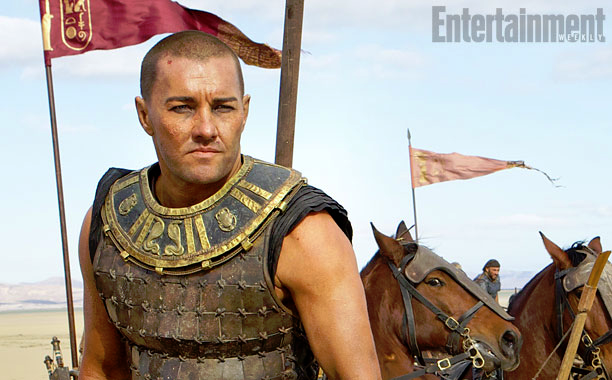
Gross. [Image: Actor Joel Edgerton squints in a manly fashion in a production photo from Exodus: Gods and Kings. He is very white.]


Here is one of the many statues of Ramses III himself.
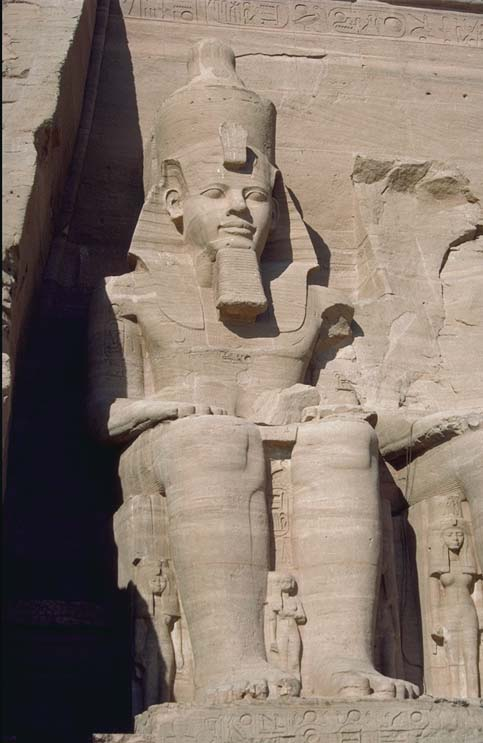
Yeah, I don’t think so. [Image: A massive statue of Pharaoh Ramses III sitting regally. His features appear to be much closer to those we associate with black people than with white people.]

What an ancient world this movie is imagining! When Middle Eastern and North African people are all white! What world is that again? DNA evidence proves that Ramses III was black. See also this incredible essay on black hair in ancient Egypt, complete with fantastic images of clearly black Egyptians.
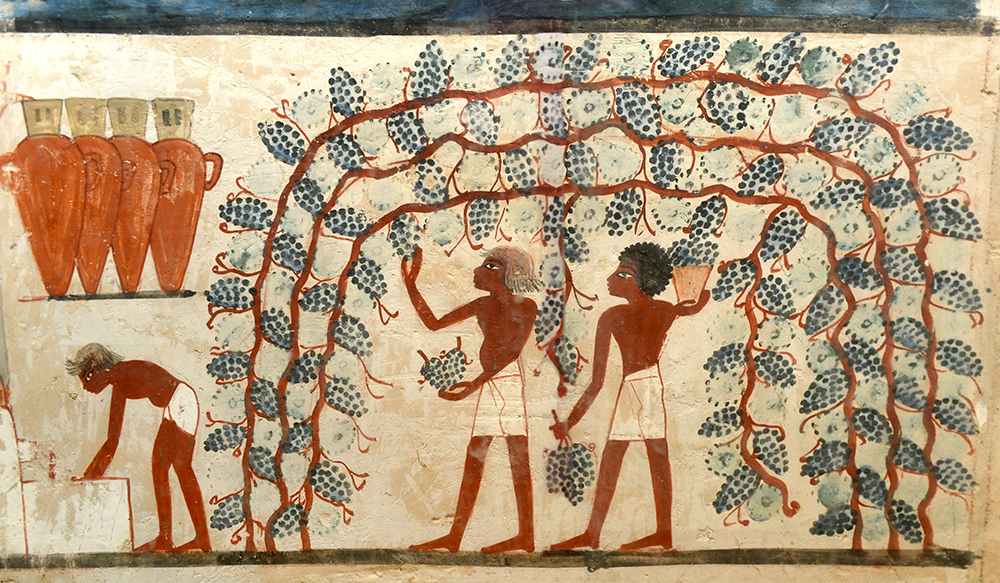
Like this one! [Image: Three men harvest grapes. All have brown skin and the man on the right has afro-textured hair.]

When you talk about representations of history, alllll these white people pop up who are EXTREMELY concerned about “historical accuracy.”

Somehow, this always boils down to: But why should people of color (and, to a lesser extent, women) exist and do things in my TV show/movie/video game? They totally could never have existed then/done that/lived there! Much-mythologized but little-understood settings, like “medieval Europe,” are strongly assumed to only consist of white people. Bafflingly, this extends to fantasy settings loosely based on Europe - i.e., Game of Thrones - where dragons and magic and sexualizing underage girls is totally fine, but a black person existing is a bridge too far. I continually wonder if these passionate defenders of “historical accuracy” know exactly how goofy they sound.

“Historical accuracy,” as used as a bludgeon by white people who are angry about people of color existing in the past, is built on a foundation of extremely poor historical understanding.
They are operating on three thoroughly false assumptions:
  1. Black people did not contribute to culture or history in the way that white people did
  2. People of different races stayed in one place forever and always, and never traveled, settled elsewhere, or encountered one another
  3. Black people have always been treated as lesser or as slaves

Whitewashing great African civilizations like Egypt (and ignoring the existence of many others- see also the Malian Empire and Mansa Musa for a start) is necessary to uphold white supremacy. Denying great cultural contributions of black people in the past makes it easier to ignore black art and philosophy and poetry today. The bigot’s thought process goes like this: It never existed, so it can’t exist now. Rupert Murdoch’s absurd claim clearly rests on assumptions 1 and 2: black people didn’t contribute to culture, and they have always been treated as slaves. In his assertion, placing white supremacy as a historical constant legitimizes whiteness and erases black history.  
When you deny people their history, it’s harder for them to push back against harmful myths or stereotypes.

Ultimately, today’s historical media has a duty to address today’s conditions. Our representations of history, the way we tell our stories, have a responsibility to know that they don’t represent history in a vacuum. People of color were rulers, inventors, writers, and lovers at the center of epic poems. They represented themselves as gods and goddesses, and were priests and philosophers and artists. Many writers have addressed the issue of representation better than I, but at the center of it all is this: Can you be what you never saw yourself being? What they said you never were?

History is both a lesson and a map. When we imagine a whites-only history, an upward march of progress based on capitalism and colonialism, we harm the people of today. History instruction in K-12 American schools is superficial at best and actively oppressive at worst - mostly because “history” is neither static nor past. We are living history right now - terrifying, scary, rise-of-fascism-in-America history. Racism never died, and hate groups have had a massive resurgence since President Obama’s election in 2008. Violent denial of black dignity, of black history and humanity, is central to white supremacy - and it’s all supported by falsely perceiving history as white.

We have always had a global world. Immigrants from southern Portugal and North Africa were buried in Ireland over 1,500 years ago.. The Islamic world traded with the Vikings.. People of color have always, always been everywhere, and people have always traveled and traded and immigrated. To imagine otherwise is simply wrong.


I never want to hear white people, in the depth of our entitlement and ignorance, demanding that their historical media be all-white. If they do, link them here. Maybe they’ll learn something.

Tuesday, November 17, 2015

The Consequences of No: #ByeFelipe and Victorian Refusal

Around this time last year, the hashtag #byefelipe emerged. This tag, and the instagram with the same name created by Alexandra Tweten, documented the way in which men instantly become angry, hostile, and threatening as soon as a woman rejects them - often, no matter how nicely. This behavior goes beyond virtual space - there are dozens of tragic stories of women who are attacked and murdered after refusing to give out a phone number or go on a date. In Detroit last year, Mary Spears was killed for refusing to give out her phone number to a strange man. If there was ever a sign that men feel absolutely, intensely entitled to women’s time, attention, and bodies, these murders are it. As there so often is, there is a racial component here as well: women of color face far higher rates of violence for saying no.


This is the scary stuff - the kind that many otherwise feminist men don’t fully grasp. There is real, tangible, looming threat of violence for saying no. One second you’re “so beautiful, baby, date me” but the second you say “no, thank you,” men can, and do, turn in an instant to wrathful, nasty, and violent. White women often receive “you’re fat and ugly and a bitch anyway” as a followup, whereas women of color have to deal with that and racist abuse.


Refusal in the America of 2015 has this miasma of male entitlement around it. We have to tread carefully, smile politely, say “I have a boyfriend” even if we don’t.


So I had to think about how women’s refusal was treated in that most misogynistic of time periods: The Victorian era. In particular, I’m going to look at Anthony Trollope's Palliser novels, set in the 1870s, in this context.


Victorian women were living in a world where spousal rape was absolutely legal. Husbands could also essentially incarcerate their wives in their homes if they chose. In the Palliser books, Laura Kennedy, a wealthy and socially prominent woman, is threatened with this loss of freedom by her husband. He only chooses to leave her alone because people would gossip about their situation, but both the characters and the narrative acknowledge that he has every legal right to do so.


The pressure to get married was an intense theme in Victorian women’s lives. Choice and independence in marriage usually depended on being independently wealthy. Women lower on the socioeconomic ladder had far fewer choices available - especially if an interested man happened to be rich.


Despite all this, there is an ideal present in Victorian literature that men should continue to be friendly with women whom they once loved, and they should accept rejection “manfully” and kindly.


Violet Effingham, a young beauty in the novels, refuses her erstwhile lover Lord Chiltern, and he respects it - even though he’s a guy with a lot of anger and rude, abrupt manners. He states directly, “It’s unmanly to persecute a girl.” Lord Chiltern asks Violet to marry him numerous times, but does not abuse or insult her for her multiple refusals. Even the women in the novel state that it’s okay to propose more than once - as long as you remain friends - but once you’ve been like, “Miss Effingham, will you make the happiest of men and be my wife?” and she’s all “Seriously, dude, I cannot give you my heart,” you tend to leave her the heck alone. There is a social contract in place where suitors, even rejected ones, are not supposed to impugn the name of a lady or insult her.


The ideal for rejected suitors was that men should behave “manfully” and accept refusal. This is an ideal, though: it’s not always enforced. It also doesn’t fully respect a “no” - asking multiple times is hardly respectful.


It’s also important to note that this is operating in a context of white womanhood, which was treated as pure and worthy of protection. You can bet your best petticoat that British men in the colonies, for example, weren’t treating native women of color with any kind of respect for refusal or their personhood.


Keeping these caveats in mind, we still shouldn’t have to look all the way back to Victorian lit to find examples of men accepting refusal and continuing to be genuine friends with the women they pursued. It shouldn’t be a high-minded ideal to NOT heap abuse and hateful words because a woman turned you down for a date.  

In Trollope’s novels, we see rich male-female friendships. Women are political actors - when “our hero,” Phineas Finn, succeeds in winning office thanks to women’s influence, his lady friend tells him, “they’ll call you the women’s pet, but you mustn’t mind that.” His political office was still won fair and square. Most of Phineas’ friendships are with women, making him a highly sympathetic character. Women were the majority of the novel-reading audience, and creating a male character who was sympathetic to them, kind, and handsome, but with believable flaws and vulnerabilities, appealed to both women and men. In 1917, a critic said that "Anthony Trollope reveals an amazing insight into the love and the motive of woman. In this detail he has no equal in the whole catalogue of British male novelists, until we go as far back as Richardson. Trollope has an amazing comprehension of the young lady.”


Trollope’s women are genuine, fully rounded people - not the sentimental cardboard cutouts of many other writers of his time. They are forced to revolve around men, who are the only ones officially able to participate in public life, but they find ways to influence the greatest public issues and politics of their day.


Trollope shows women who are spirited, independent, and want a marriage with real love in it. They also want the right to change their mind, like Violet Effingham - who does eventually decide to marry Lord Chiltern - and remain friends with men whom she had rejected. Violet had “a peculiar gift for that friendly intimacy” with jilted lovers. Sounds like a lot of emotional work,  but she was able to operate under the expectation that a refusal didn’t equal automatic abuse.


This nuanced portrayal of women was accepted with cheering approval by the reading public, suggesting it rang true for most readers. Trollope enjoyed popularity on par with Dickens in his time, despite a slight falling-off in the later years of his life.

Trollope wrote some of the most popular novels of the 19th century, depicting ideals of behavior that demanded politeness and had no space for abusing women who refused. There’s plenty to leave behind in the Victorian era, but men could learn from this basic concept, and extend real courtesy to ALL women - whether they say yes or no.

Tuesday, April 14, 2015

"The List is the Origin of Culture:" or, be glad today's listicles aren't all about sheep

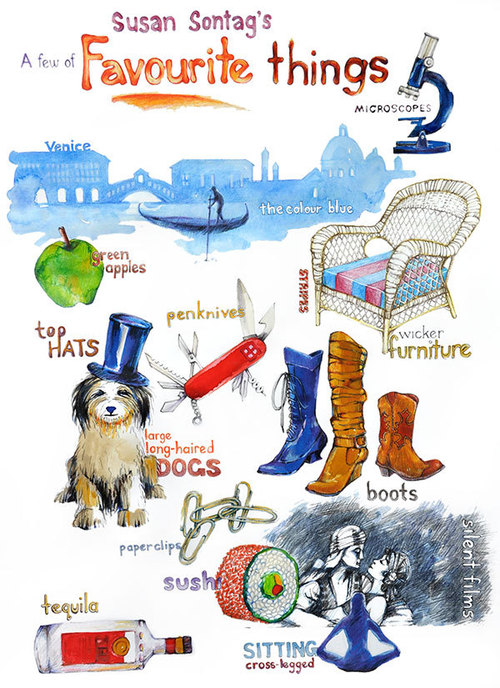
Umberto Eco wrote that the list was the beginning of culture. Susan Sontag made lists of what she liked and disliked. Nabokov made lists of things he hated.

Illustration of Susan Sontag’s favorite things by Lynore Avery on Brainpickings.

And lists go back way, way further. Some of the oldest written records, Sumerian tablets, contain lists of tribute that make such important distinctions as those between “fat sheep” and “fine fat sheep.” Lists make accountability and accuracy possible (you might really need to make sure those sheep were gonna be both fine AND fat, okay?). The need for accuracy in trade and tribute was probably the very genesis of Sumerian script.

The other main Sumerian genre was religious literature. Poetic entreaties to the goddess Inanna by one of the first recorded poets, a woman named Enhueduanna, comprise some of the oldest written prayers. What is a prayer if not a list? In this one, the attributes of the goddess and the fervent hopes of the believer form an endless litany of items.

You might say a list has no inherent narrative, but it doesn’t take much to give it one - or to make a list that evokes a familiar story. The girl, the stepmother, the work, the weeping, the ball, the prince, the shoe. See? A simple list of symbols, archetypes, can tell us everything. This particular list is a refraction of culture and not an underpinning of it, but Cinderella is a story whose elements appear in almost all cultures (I absolutely love the Chinese version). If lists begin history and culture, they can also help classify and understand it.

Lists may not be narrative, but they can tell a story. Take royal inventories and household records. Just by her Household Book, a ledger recording everything about the money and items needed in royal life, we know Queen Isabella of England and her attendants regularly took baths. Medieval people are all smelly and unwashed, right? Not these aristocratic ladies - Isabella’s Household Book for 1311 records lists of wooden bathtubs and bathing clothes, and payments for regular repairs to each. Already, this list has changed the story. We also know that medieval people usually slept naked, but that aristocratic ladies like Queen Isabella ordered “bathing garments” to go with their tubs. Priorities.

Today, the “listicle” is loudly decried as the end of journalism and proof of laughable modern attention spans. Sites like Buzzfeed and Cracked are supposed to represent the lowest common denominator, “clickbait” intended just to briefly entertain the masses - even though these days Buzzfeed is doing amazing, “serious” journalistic work in addition to “The 10 Disney Moments that Make You Cry Like a Baby” (ok, I made that one up, but I wouldn’t be surprised. And I’d click on it). While The 22 Chicken Wings You Have to Try Before You Die may not seem up there with fervent prayers to Inanna, lists have a long and glorious history. And plenty of those venerable cuneiform tablets were just talking about sheep, anyway.


Further Reading:
Queen Isabella, by the incredible Alison Weir, who turns royal account books into spellbinding narrative.
As Consciousness is Harnessed to Flesh, Susan Sontag’s notebooks from 1964-1980, where she writes “I create value. I confer value....Hence, my compulsion to make ‘lists.’”