Tuesday, April 14, 2015

"The List is the Origin of Culture:" or, be glad today's listicles aren't all about sheep

Umberto Eco wrote that the list was the beginning of culture. Susan Sontag made lists of what she liked and disliked. Nabokov made lists of things he hated.
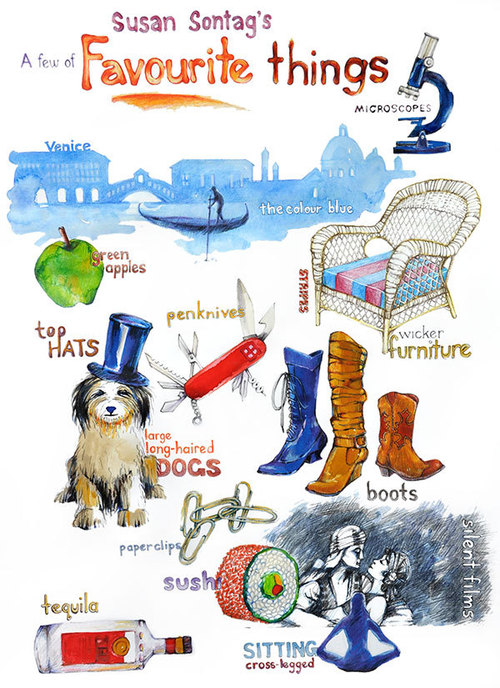
Illustration of Susan Sontag’s favorite things by Lynore Avery on Brainpickings.

And lists go back way, way further. Some of the oldest written records, Sumerian tablets, contain lists of tribute that make such important distinctions as those between “fat sheep” and “fine fat sheep.” Lists make accountability and accuracy possible (you might really need to make sure those sheep were gonna be both fine AND fat, okay?). The need for accuracy in trade and tribute was probably the very genesis of Sumerian script.

The other main Sumerian genre was religious literature. Poetic entreaties to the goddess Inanna by one of the first recorded poets, a woman named Enhueduanna, comprise some of the oldest written prayers. What is a prayer if not a list? In this one, the attributes of the goddess and the fervent hopes of the believer form an endless litany of items.

You might say a list has no inherent narrative, but it doesn’t take much to give it one - or to make a list that evokes a familiar story. The girl, the stepmother, the work, the weeping, the ball, the prince, the shoe. See? A simple list of symbols, archetypes, can tell us everything. This particular list is a refraction of culture and not an underpinning of it, but Cinderella is a story whose elements appear in almost all cultures (I absolutely love the Chinese version). If lists begin history and culture, they can also help classify and understand it.

Lists may not be narrative, but they can tell a story. Take royal inventories and household records. Just by her Household Book, a ledger recording everything about the money and items needed in royal life, we know Queen Isabella of England and her attendants regularly took baths. Medieval people are all smelly and unwashed, right? Not these aristocratic ladies - Isabella’s Household Book for 1311 records lists of wooden bathtubs and bathing clothes, and payments for regular repairs to each. Already, this list has changed the story. We also know that medieval people usually slept naked, but that aristocratic ladies like Queen Isabella ordered “bathing garments” to go with their tubs. Priorities.

Today, the “listicle” is loudly decried as the end of journalism and proof of laughable modern attention spans. Sites like Buzzfeed and Cracked are supposed to represent the lowest common denominator, “clickbait” intended just to briefly entertain the masses - even though these days Buzzfeed is doing amazing, “serious” journalistic work in addition to “The 10 Disney Moments that Make You Cry Like a Baby” (ok, I made that one up, but I wouldn’t be surprised. And I’d click on it). While The 22 Chicken Wings You Have to Try Before You Die may not seem up there with fervent prayers to Inanna, lists have a long and glorious history. And plenty of those venerable cuneiform tablets were just talking about sheep, anyway.


Further Reading:
Queen Isabella, by the incredible Alison Weir, who turns royal account books into spellbinding narrative.
As Consciousness is Harnessed to Flesh, Susan Sontag’s notebooks from 1964-1980, where she writes “I create value. I confer value....Hence, my compulsion to make ‘lists.’”

Wednesday, June 8, 2011

Rage Against Letters to the Editor: Or, I am Worth More Than a Gold Necklace

The following scary bit of victim-blaming was somehow allowed in to the Letters to the Editor page of the Washington Post today. It was written in response to Jessica Valenti's excellent look at SlutWalks. (For more SlutWalk info, check out this awesome post by Holly Pervocracy).

"I couldn't disagree more with the unrealistic premise and immature slogans the new feminists espoused in Jessica Valenti's Outlook commentary. A simple analogy sums it all up: American capitalism relies heavily on advertising. An advertised product sells. Advertising works!
"Advertising your body works as well. Walking the streets in a high-crime area while wearing a gold necklace is stupid. Let's likewise be smart about the way we dress." - Ingrid Wrauseman, victim-blamer

Besides the extremely obvious "you absolutely deserve to be raped if I don't think you were acting acceptably" not-so-sutble subtext which is the basic underlying principle of all Victim Blamers, what I find scariest is what the whole "advertising" thing really means. "Advertising" your body like a gold necklace and then being raped has to mean that rape was the desired result - like someone buying the product that's being shilled. Not only are women asking for it, they want it! In this case, the product being advertised is women's bodies, and the "sell" is...rape. Wait, what?

This is the transactional model of sexuality at its stark conclusion. Under this model, sex is a thing that men take from women, whether they pay in the form of dinner and drinks or with emotional attachment (apparently, women never have sex because they like it). If women advertise their sexuality or attractiveness or even femininity, then sex will be forcibly taken from them just like that gold necklace. In this scenario -- under the transactional model of sexuality -- not only is the horrific experience of rape equated to a mugging, it is also cast as a what-did-you-expect microcosm of capitalism.  Advertise the product, dear, and someone will buy it whether you're selling or not.

This woman apparently believes that her fellow women are just things. We are objects that had better be careful of how we dress and act around men, because if we "advertise" by being attractive or dressing in an unacceptable way then we will be bought or stolen. And men, here, are just muggers who can't control their apparently animal urges long enough to imagine that women are people. But hey, if the author can't conceive of that, how on earth could men?

I have to believe that men are worth more than that. I believe that men can and should respect women as human beings no matter what they're wearing. I have to hope that men see female sexuality and bodily autonomy as more than a "gold necklace" that's theirs for the taking. I believe that the majority of men are not rapists.

And finally, though it's been said before and better: I am worth more than a gold necklace. I deserve the right to walk whatever streets I choose in whatever clothes I'm wearing. I am no billboard, no coupon, and no advertisement. I am not for sale.

Friday, April 1, 2011

Anti-Life: This is What an Angry Feminist Looks Like.

I don't remember the specific moment of epiphany when I realized this, but it becomes more and more clear the more I educate myself on legislation that relates to reproductive/sexual health and federal funding for women and children's programs.

It dawns on you slowly at first, but then becomes crystal clear and even painfully obvious. The epiphany? Right-wingers are against life. The moment you get out of the womb, they absolutely do not give a shit about you.* Okay, maybe they care if you're white, rich, male, and abled, but god forbid if you're female, disabled, poor, or any shade besides lily-white. They are as thoroughly against living as you can be. This is shockingly evident in HR-1, the Republican proposal to (de-) fund the federal government.

If Republicans were for life, and for the lives of women and children in particular, would they vote for HR-1, which slashes $747 million dollars from WIC, the Special Supplemental Program Nutrition Program for Women, Infants, and Children? This program provides food and counseling for low-income mothers and families. It saves the lives of infants whose parents literally cannot afford to feed them.

Yup. It keeps babies healthy, happy, and alive. 

Aren't anti-choicers really into that stuff? Isn't the lives-of-babies thing like their whole bag? Funny...I don't hear the Family Research Council, or the Catholic Family and Human Rights Institute, or any other conservative group talking about the fate of the millions of women and babies who receive assistance from this program. Hm- this seems a lot more like hating on poor people and single mothers. How strange.

If Republicans cared about children the second after they exited the womb, would they cut $1 billion dollars from Head Start and $39 million from childcare programs? These programs provide a safe place for parents to put their children while they work. Without programs like these, children will get left alone or with incompetent caregivers, which negatively impacts their safety. Imperiling children...doesn't sound very pro-life to me. It fact, it sounds like another stab at poor people and single moms (the ones who are most likely to need childcare so that they can go to work to, you know, support their children).

When Republicans start caring about life in all its forms, I will respect their position on forcing women to carry pregnancies to term (well, I won't, because it's awful, but at least it will make logical sense).

When Republicans start fighting for nutrition for babies, for responsible care for children, for prenatal care for all women regardless of documented status, for the abolition of the death penalty, for the end to wars (what else is more anti-life than war?), for sound environmental and wildlife policy (do non-human lives matter?), and for the lives of the poor and the disenfranchised, maybe then they can call themselves "pro-life." When women's and children's lives are respected as much as rich male ones, then they can call themselves "pro-life."

Start caring about the quality of my life, guys, and the lives of my future children. Then call yourselves "pro-life."


*I am specifically talking about the folks in Congress who consistently work in this direction, as well as the people at various conservative organizations who directly lobby for these causes and call themselves "pro-life." I realize that not every single lay Republican holds these views, but find me a dozen of these law- and policy-makers who are against these specific positions and have said so publicly, and I'll give you five dollars.

Friday, January 7, 2011

Pink and Blue: From the Mouths of Babes


So I take care of kids for a living. (This statement is somewhat facetious, as I am lucky enough to have parents that pay for a bunch of my stuff). So not really a living per say, but you could say it is my main trade. Childcare is one of my most accomplished and marketable skills. I have a ton of experience doing it, and have worked as a full-time nanny for the last two summers.

And it makes me twitch when I see the extent to which children are gendered. From their earliest moments, before they are more than wrinkle-faced blobs, kids are subject to adult assumptions of how they should behave based on the gender they are assigned at birth. And these tiny people have ears, and they begin to internalize what you say to them before they can speak themselves. Children are sponges, and this comparison extends far beyond the fact that both things are clingy and often slightly damp. At a very early age, you will find them trying to figure out how gender works in our culture.

One of my frequent charges, who for the purposes of the internet we will call L, is male (as far as I know), five years old, and possesses the largest, roundest, and bluest eyes you've ever seen before. He asked me something very interesting when I was watching him recently. He had been remarking, with a sage and furrowed brow, on the oddness of the fact that I was wearing boxers which were slightly visible above my sweatpants (it was 8 AM, so sue me) and the fact that I had short hair, yet I was referred to as female.

He asked me, "Do you think you're a boy or a girl?"

Now consider the wisdom in that statement, delivered to me from about three feet off the ground and from behind a large gap where two front teeth are missing. Behind that adorable face, the wheels are turning like crazy as he tries to figure out all this gender stuff. He doesn't even know the word "gender"! But- he used the word think. Did I think I was a boy or a girl? How did I feel about the matter? Never mind everybody else, what did I think, personally?

L. wanted to know how I felt about my gender, and that is more courtesy than most adults will give you. I speak broadly and I certainly do not speak for everyone, but I believe the average gender-variant/transgender/genderqueer individual would kill for that kind of consideration from the world at large. I consider myself to be somewhat genderqueer, though generally comfortable with female-oriented labels, and nobody would ever think to ask me this. I was stunned, and in the best possible way.

I managed to steer the question away from myself (as prescient as he is, the concept of genderqueerness is still a little heavy for a first-grader) and instead took the time to talk to him about how we are all allowed to like whatever we like, and how there is no "girl stuff" or "boy stuff" or even really sharp divisions between "girls" and "boys," but instead there is just "stuff," and "people." He took it all in better than any adult to whom I've ever had to explain the gender spectrum.

What I'm saying- "my point, if I had one," as my father would say- is that despite all the binary messages that children get from the world at large, they are sponges. They will listen if you speak! And if you tell them not to worry about boy/girl and pink/blue, then, when they grow up, we might find ourselves with a generation that is easy in their minds, in their bodies, and in their genders- whatever those genders may be.

Wednesday, December 15, 2010

I will hold out- I will scream and I will shout

This post on Yes Means Yes really made me think. It discusses the "boiling frog" principle and applies it to sexual assault- how women are taught, throughout their whole lives, not to raise their voices, put up a fight, or make a fuss. I think it also applies really well to street harassment.

I wasn't always as brave as I am now. I wasn't always as willing or able to kick and scream and raise absolute hell when I was being made to feel afraid. I credit internet feminism with bringing out my natural belligerence, and I couldn't thank the movement enough. Because of discussions on amazing blogs like Yes Means Yes, Jezebel, figleaf, and the rest, I feel like I have the right to enforce my boundaries and protect my privacy in a way that makes me feel safe. This wasn't always true.

A couple of years ago, when I was maybe 17, I was hanging around my town library on a Saturday afternoon, waiting for the guys at the tire place to be done fixing up my car. I was in the stacks, idly perusing titles, when a guy came up to me and asked the time.

"One-fifteen," I answered, or something like that. I barely looked at the guy- I was too busy looking at books. Then he went away, and I continued wandering around the shelves.

After a minute or two, I became aware that this man was following me as I walked around. He was also doing that stereotypically creepy heavy-breathing thing as he did so. I was immediately terrified- my heart was racing almost instantly.

This man was making me feel so unsafe. I was in a library with tons of other people, but what did I do? Did I tell a librarian or another adult? Nope. Even though I felt, distinctly, that what was happening to me was not okay, I wasn't sure enough. I didn't feel that I could tell someone and not be laughed at or brushed off. What if this wasn't really happening? Should I really make a fuss?

This man proceeded to follow me out of the library and into the Whole Foods next door. My rationale: maybe if there are lots of people then he won't follow me in. This plan did not work. He followed me in and then sat down a few tables away from where I sat, staring at me.

This is when I thought that I had to tell someone, so I called my dad. I told him what was happening and that I was freaking out, and he helped me stay calm. He told me to stay where there were lots of people, and to try and go get my car.

So, still on the phone with Dad, I made my way out of the Whole Foods and down the street. For one happy second I thought the creepy guy was done following me, but I looked back and my heart sank as I saw he hadn't given up on his mission of making a teenage girl so afraid she felt like throwing up.

He followed me all the way down the street- several blocks- staying maybe fifteen feet behind me the whole time. As I walked, my all-encompassing terror started to subside even as the adrenaline kept pumping. What right does this guy have? I kept thinking to myself. What right does he have to make me so afraid in my own hometown? This isn't okay. I deserve to feel safe.

Finally, I was crossed the street to get to the tire place where my car was. My heart leapt into my throat again as I contemplated the thought that this dude would know which car was mine. I couldn't let that happen.

I turned around to face this guy, who was in the middle of crossing the street (I secretly hoped that maybe he would get hit by a car, but no such luck) and I said, as loudly and forcefully as possible without actually yelling, "Would you PLEASE stop following me?" He muttered something unintelligible and vaguely apologetic-sounding and walked away to leave me alone at last.

I felt victorious, at first, but also drained from the whole traumatic experience. The whole time, worst-case scenarios had been racing through my head. What if he has a gun? Or a knife? What if he tries to hurt me or rape me? With him gone, I could finally breathe, but I had to reflect on how unsafe women are made to feel in public space. Would a cisgender male ever have put up with this crap? No, not in a million years, huh? Then why the hell should I? After that day, I promised myself that I would do whatever was in my power to never allow anyone to make me feel that way again.

More than anything, I wish that no person ever had to feel this way. I should never have to realize that I should never be made to feel unsafe in a public place- it should just be a given, like how 99.99% of men walk around every day without being intimidated, catcalled, followed, or harassed in any way. I deserve to feel safe- just like the other half of the population.

Saturday, October 16, 2010

Sappho: Restoring that which is beautiful to its rightful place

In my women in antiquity class, which is taught by my very attractive classics professor (on whom I and most of the rest of the class have a massive crush), we've been talking about Sappho, famously gay lady poet of the 3rd century BCE. 


While both my professor and I are inclined to believe in her gayness ( My professor knows better than I, since her PhD was on the biographical tradition of Sappho in antiquity, but I was sort of already convinced for lots of reasons) there is this alternate historical tradition where you read her gay poetry with hetero blinders so it comes out as "affection toward her students" or "they're really just wedding hymns, guys" or, alternatively, the simple hysteria response of "why does everything have to be GAY with you people?!"


Of course, it's not really about co-opting everything to be gay just because now we actually have a queer-positive lens through which to view history, and we're going to paint everything rainbow just because we can. It's more about seeing things in a way that we ("we" being feminist/gay/queer-positive historians and translators) were never allowed to before, and in reconstructing that which has been purposely buried or lost. Sappho especially was incredibly censored, particularly during the 19th century, by both translators and commentators. In the 1800s, prominent scholars saw Sappho's most explicit (and beautiful) declaration of desire for another woman, poem #2, as a "homosexual psychotic breakdown."


So much of history, at this point, is about resurrecting lost voices. We see this in the rising history of indigenous peoples who were colonized by Europeans, in women-inclusive history, and in the history of slaves in the American South and the Caribbean. These are all relatively recent movements in scholarship that have picked up intensely since their beginnings in the '70s and '80s, finally making history about other groups of people besides straight white men. These are all efforts towards creating a fuller portrait of societies that came before ours, and without this larger sense we can't hope to understand the past.


A huge part of our job as historians is thus to restore what has been censored or effaced or conveniently forgotten. I hope I can continue that fight as I do research and study history. Without those on the edges and the margins, we'll never see the bigger picture.

Saturday, September 11, 2010

VIrgin/Whore: I wish we could stop talking about it

Fellow college-age blogger Abi wrote this post about “purity,” and about kids being kids, over-sexualization, etc., and I have some things to say about it. Her whole post can be found here: http://imhavinsuchagoodtime.blogspot.com/2010/06/what-shame.html

First of all, I don't like “purity.” I really don't like it. This concept has been used right up to the present day,as a way to make women act in a certain and prescribed manner. There should be no expression of sexuality because that threatens patriarchal control over women's lives. These ideas, when run through the modern Christian right-wing movement, make people say things like this, from Abi's post:

What does it matter if I have sex with every guy I'm attracted to, or even not attracted to? Why shouldn't I? Girls and guys are crumpling to the demands of society, of peer pressure, of lust, and of pure emotion with no backing. It seems we've forgotten the power that comes with purity.”

Falling to peer pressure is bad. And the reason it happens is because society creates this pressure cooker, in which sexuality has to be proven, performed, gossiped over, and salaciously relished.

The problem is, this pressure cooker is, at least partially, created by an adherence to “purity” and virginal behavior as the ideals that women should aspire to. If you're supposed to be a “good girl,” who doesn't exercise her sexuality or flash any skin, and then you deviate from this norm, it becomes a big frackin' deal that everybody has to discuss, gossip, salaciously relish. It wouldn't be salacious if that unreasonable virginal ideal wasn't there, and if we could safely exercise our sexuality with whomever we saw fit.

If we didn't have to fit the modest mold of the virginal pure girl, then we wouldn't have the “bad girl” or the “fallen woman” archetypes, either, and we might have just that much more freedom without the fear of retribution, judgment, and hatred. If we, as a society, didn't create this framework to hold women and femininity captive, wouldn't everyone of all genders be that much freer to explore and play and flaunt as much as they pleased?

So where is the power that comes with purity? I can only see this emphasis on circumscribed sexuality as a highly negative force. Abi goes on to say the following:

I wore overalls until sixth grade. I didn't wear make-up until eleventh. I was running around and having a super childhood, and I didn't care to be older than I was, wear short skirts, talk on a cell phone, or chase boys. Now I look at young girls and they're all dressing like little whores “

First of all, I can't stand the narrative of makeup as a bad mature thing that you're not allowed to use until you're older. I'm glad that I got a ridiculous shiny purple makeup box when I was around 11 or so that let me turn my face into a work of art. I wanted peacock-blue eyelids and green lips and glitttery cheeks. I wanted to be a chrome-washed robot or a jeweled space alien, and that goofy technicolor kiddie makeup let me express anything I wanted in the safety of the bathroom mirror. Later, when I got involved in theatre, I learned the importance of makeup as a mask, as an illusion, that lets you become anything and anyone. Makeup is just a thing, and it can be used in negative ways just like anything else. But cosmetics are in no way intrinsically bad, and they can be amazing in many ways. Makeup lets you become both the canvas and the artist, so don't demonize the paints.

Secondly, I don't think it's okay to say that “all” young girls dress like prostitutes- or to use the word “whores” in reference to young girls, period. I don't think it's true, for one- in my personal experience as a babysitter and nanny, I have encountered very few little girls who didn't dress their age. The little girls that I've had the pleasure to take care of have been running around in muddy jeans and sneakers (and yes, overalls!), very much enjoying their childhoods. This is where I would say, at least on the basis of what I've seen, that the kids are generally doing all right.

But I do believe that over-sexualization is a problem, especially when it is foisted onto young people at an age when they aren't able to first figure things out on their own, and so they start mimicking what they see on TV and the internet and all the other oh-so-youth-corrupting forces of today. The cultural narrative that frames sex as a performance that you should start on right away if you want to be cool and accepted has obviously got to change.

It is precisely because of this performance-oriented attitude that I think we, as a people, need to stop holding "purity" as the only acceptable way to perform sexuality. If we uphold purity as an ideal, we stifle self-expression and the healthy exploration of an essential part of life.

So, over-sexualization is bad, and so is the imposition of “purity,” and they are two sides of the same coin. Every time we, as a society, impose either side of this dichotomy, we are getting up in young people's sexual business, which is totally unwise and utterly unfair to everyone involved. Don't impose strictures of shame and fear on exploration, experience, and physical learning. Instead, provide open, inclusive, available, and scientifically accurate sex ed, and let kids do their thing. Young people are not idiots, and they have opinions and brains of their own. They are not going to engage in behavior they're not ready for if they're given an open and safe cultural environment where they can choose how to develop and explore their sexual lives. 

It is so hurtful for the norm, the ideal, the aspiration, to be “purity.” That's what you're supposed to strive for, and if you fall short, then you're just a whore. But if you take away that expectation, that don't-you-dare-explore-because-it's-bad mentality? And you have a much more open and free space for sexuality in society, where young people can be sexual at their own pace, in safe environments, when they choose to do so.

This is all from a pretty hetero-centrist perspective, as you can tell. I am talking basically about straight kids, since queer culture (to make a large generalization) usually tends to be more sex-positive and less slut-shamey.

Other people have written about this issue far more brilliantly, so check out Jezebel has to say about a very creepy aspect of this whole business- purity balls.